
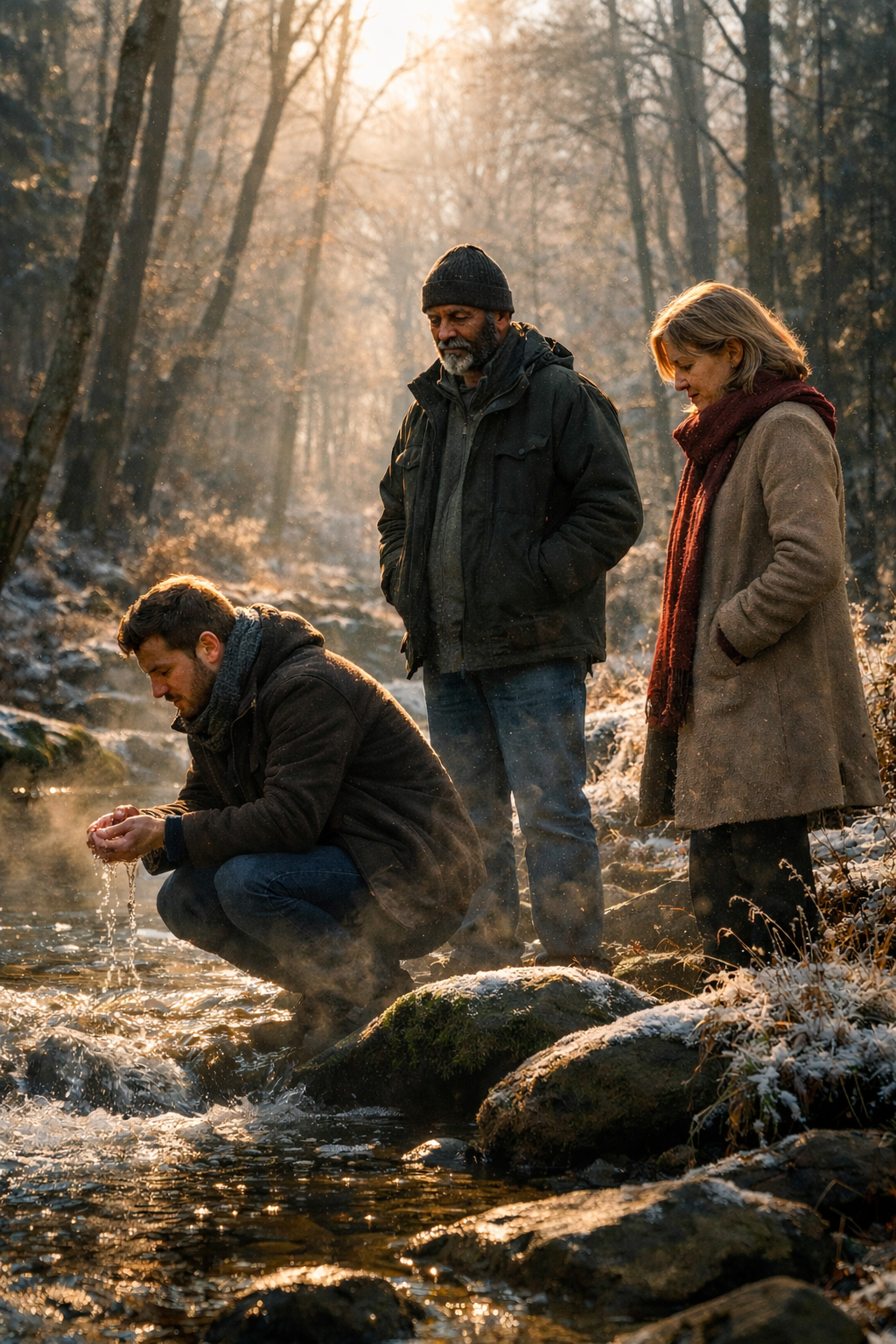
As winter settles into the hills, Elijah, Jeremiah, and Barbara discover that the truest fire does not roar—it waits, refines, and calls the heart to stand.
The morning arrived wrapped in a thin, pewter-colored light, the kind that softened edges without erasing them. Frost clung to the bare branches like a fragile memory, and the gravel path behind the old retreat house whispered underfoot. Elijah walked ahead, hands tucked into the pockets of his wool coat, shoulders slightly hunched—not from the cold alone, but from the weight of something unspoken. His breath came out in steady plumes, each one briefly visible, then gone.
Jeremiah followed a few steps behind, his stride slower today, deliberate. He carried a thermos in one hand, the metal scarred from years of use, the lid clicking faintly with each step. His brow was furrowed, not in worry exactly, but in discernment. He had learned—often the hard way—that God’s movements were rarely hurried. The prophets knew this. So did anyone who had waited long enough to hear.
Barbara brought up the rear, her scarf pulled high against her chin, eyes alert and thoughtful. She noticed everything: the way Elijah’s shoulders tightened when the wind shifted, the way Jeremiah paused before each bend in the path as though listening for something beneath the silence. She felt it too—a pressure, gentle but persistent, like a hand at the small of her back urging her forward.
They reached the clearing just as the sun finally crested the tree line. Light spilled across the frost, igniting it into a million brief sparks. Barbara stopped short, catching her breath. “It looks like the ground is burning,” she said quietly.
Elijah turned, a faint smile touching his mouth. “Fire without consumption,” he replied. “Moses would approve.”
Jeremiah let out a low chuckle and set the thermos on a flat stone. “Or Elijah,” he said, glancing at their companion. “Fire has a way of following you.”
Elijah’s smile faded, replaced by something more sober. He looked out over the clearing, eyes narrowed, as if weighing the truth of that statement. “Fire,” he said slowly, “is easier to recognize when it’s loud.”
Barbara stepped closer, her boots crunching softly. “But not always truer.”
They stood there for a moment, the cold seeping through soles and seams, the air sharp with the clean scent of pine and earth. Somewhere in the distance, a crow called—one harsh note, then silence.
Jeremiah broke it by pouring coffee into the lid of the thermos. Steam curled upward, carrying a bitter warmth. He handed it to Elijah first, then Barbara. When he finally poured for himself, he spoke without looking up. “I was thinking about the cave again,” he said.
Elijah’s fingers tightened around the cup. “Horeb.”
“Yes,” Jeremiah said. “The mountain of God. After the wind, the earthquake, the fire—nothing. And then, a still small voice.” He lifted his gaze. “Or, as some translations put it, a sound of gentle stillness.”
Barbara nodded. “It’s unsettling,” she said. “We expect God to announce Himself with force. But He whispers.”
Elijah took a sip of coffee, grimaced slightly at the heat, then welcomed it. “I didn’t want the whisper,” he admitted. “I wanted vindication. I wanted noise that proved I was right, that the struggle had been worth it.” His eyes dropped to the ground. “But the Lord asked me a question instead: What are you doing here?”
The words settled among them, heavy as the frost-laden air. Barbara felt their weight press inward. She had asked herself that question more than once lately, in the quiet hours before dawn when prayer felt like walking through fog. What are you doing here?
Jeremiah leaned back against a tree, its bark rough against his coat. “The question wasn’t condemnation,” he said gently. “It was invitation. God wasn’t done with you.”
Elijah exhaled, a long, slow release. “No,” he said. “He rarely is.”
They began to walk again, circling the clearing. As they moved, Barbara noticed how the light changed, how shadows lengthened and shortened with each step. It reminded her of Jeremiah’s words from earlier days, spoken beside a stream in the woods: ‘Blessed is the one who trusts in the Lord, whose confidence is in Him. They will be like a tree planted by the water.’ She had carried that image with her—the rootedness, the quiet resilience.
“Do you ever feel,” she said now, choosing her words carefully, “like obedience is heavier than rebellion?”
Jeremiah stopped. Elijah did too, turning to face her. The wind stirred Barbara’s hair, lifting a few loose strands across her face. She brushed them aside, meeting their eyes.
“Rebellion,” Elijah said, “burns hot and fast. Obedience smolders. It takes time.” He looked away, jaw set. “And it costs more.”
Jeremiah nodded. “The prophet’s burden,” he murmured. “To speak when no one wants to hear. To plant when there’s no rain in sight.” His voice softened. “Jeremiah—my namesake—called it a fire shut up in his bones. He tried to hold it in, but he couldn’t.”
Barbara smiled faintly. “And yet he also said the heart is deceitful above all things.” Her gaze dropped to her hands. “Sometimes I can’t tell whether the fire I feel is God’s or my own.”
The admission hung between them, honest and raw.
Elijah stepped closer, his expression gentler now. “The test isn’t how it feels,” he said. “It’s what it produces.” He gestured toward the trees. “Fire that is from the Lord refines. It leaves behind fruit—justice, mercy, humility.”
Jeremiah added, “Micah said it plainly enough. What does the Lord require of you? To act justly, to love mercy, and to walk humbly with your God.”
Barbara closed her eyes, letting the words wash over her. When she opened them again, there was moisture at their edges, but her voice was steady. “Then why does humility feel like loss?”
“Because it is,” Jeremiah said without hesitation. “But it’s the kind of loss that makes room.” He tapped his chest lightly. “Less noise here. More space for the whisper.”
They reached the far edge of the clearing where the ground sloped downward toward a narrow ravine. A stream ran through it, mostly hidden by brush, but its presence was announced by a constant, low murmur. Barbara felt drawn to it and started down the incline. Elijah and Jeremiah followed.
At the water’s edge, the air felt different—cooler, heavier with moisture. Moss clung to stones, and the smell of wet earth rose up, rich and grounding. Barbara crouched, trailing her fingers in the current. The cold bit sharply, then numbed.
She thought of Mary, breaking the jar of expensive perfume, filling the house with fragrance. The aroma of Christ, Paul had called it—a scent of life to some, death to others. She wondered what fragrance her life carried. Was it pleasing? Or merely loud?
“Elijah,” she said, standing. “You once called fire down from heaven. You saw it consume the offering, the stones, even the water. But it was after that victory that you ran.” Her eyes searched his face. “What scared you more—the prophets of Baal, or Jezebel’s threat?”
Elijah’s jaw tightened. For a moment, Barbara thought he might not answer. Then he did, voice low. “The silence after,” he said. “When the crowd went home and the mountain was quiet again. I realized I was still alone.” He looked at the stream, its surface catching the light. “Victory doesn’t always cure fear.”
Jeremiah placed a hand on his shoulder, a simple, grounding gesture. “That’s why God sent you back,” he said. “Not to the mountain, but to people. To anoint kings. To find Elisha.” He smiled slightly. “To remind you that you were never meant to carry the fire alone.”
Barbara felt something settle in her chest, a quiet affirmation. Community wasn’t an accessory to faith; it was part of God’s design. Even prophets needed companions.
They lingered by the stream, the minutes stretching comfortably. The sun climbed higher, and the frost began to retreat, dripping softly from branches. Elijah knelt, cupping water in his hands, then letting it spill back into the flow.
“Fire and water,” he said. “Judgment and mercy. They’re not opposites. They work together.”
Jeremiah nodded. “Like pruning and growth.” He glanced at Barbara. “Like silence and song.”
Barbara smiled, warmth spreading through her despite the cold. She straightened, shoulders back, as if making a quiet decision. “Then let this season be one of quiet fire,” she said. “Not spectacle. Not noise. Just faithfulness.”
Elijah rose, his expression resolute. “That kind of fire,” he said, “changes everything.”
They began the walk back as the day fully awakened around them. Birds flitted between branches, their calls light and insistent. The retreat house came into view, smoke curling from its chimney. Life continued—meals to prepare, prayers to offer, words to speak when the time was right.
As they reached the path, Jeremiah slowed, his voice thoughtful. “The Lord told His people once, Stand at the crossroads and look; ask for the ancient paths.” He met Barbara’s gaze. “Sometimes the next step forward is a step deeper.”
Barbara nodded, feeling the truth of it in her bones. She didn’t know exactly what lay ahead—only that obedience would require listening more than speaking, waiting more than acting. But she also knew this: the whisper was enough.
Behind them, the clearing lay quiet again, the frost gone, the ground ordinary and holy all at once. Fire unseen, yet present.
Closing Prayer
Lord of wind, fire, and gentle stillness, teach us to recognize Your voice when it whispers. Refine our hearts, root us deeply in Your truth, and let our lives carry the fragrance of Christ. Give us courage to obey in quiet faithfulness. Amen.