
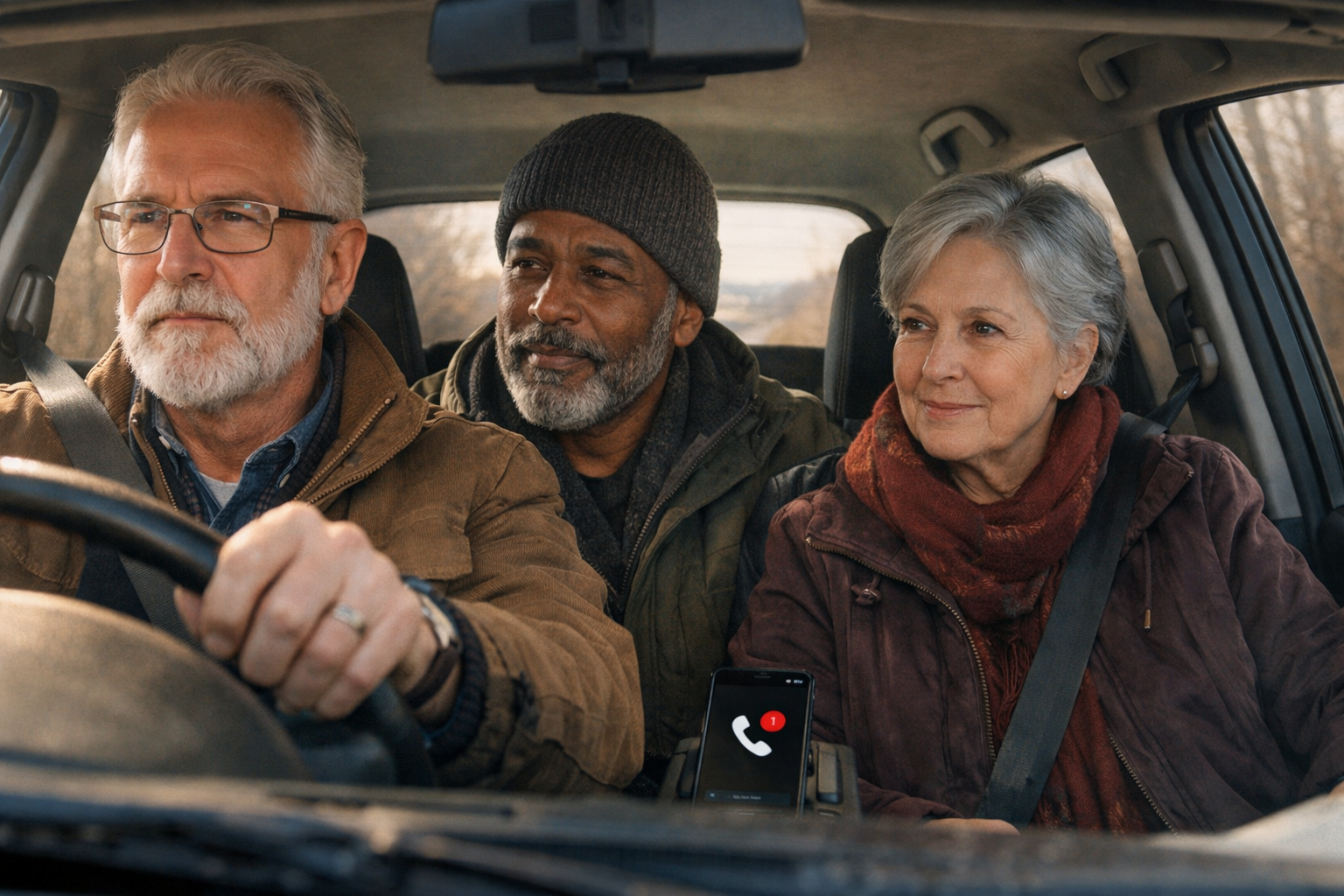
After the retreat ends and the chapel empties, Elijah, Jeremiah, and Barbara discover the real test of quiet fire—carrying gentleness into phone calls, conversations, and the ordinary miles back home.
The road out of the retreat grounds curved like a slow thought. Frost still clung to the shaded ditches, and the bare trees stood shoulder to shoulder, their branches knitting a gray lace against the morning sky. The sun had climbed, but it felt distant—more like an idea than a warmth. Every now and then, a sheet of ice cracked loose from a pine limb and dropped onto the leaves below with a sharp, clean sound, like a snapped twig.
Elijah drove.
His hands rested steady on the wheel, knuckles pale where his grip tightened and relaxed in a rhythm he didn’t seem to notice. His glasses caught the light when he turned his head, and the trimmed white beard along his jaw made his face look carved—older, yes, but not weary. More like seasoned wood: tested, capable, and still useful.
Jeremiah sat in the passenger seat, knit cap pulled down to his eyebrows, shoulders broad inside his heavy jacket. He watched the road the way he watched people—not suspicious, just attentive. His beard, salt-and-pepper with more gray than not, moved slightly when he hummed under his breath, a tune with no words. It sounded like something he’d heard long ago and never entirely put down.
Barbara sat behind them, scarf wrapped close, gray hair neat and practical, hands folded in her lap. She looked out the window and then at the two men, reading their faces like a familiar page. Her eyes were soft, but they missed nothing.
For a while, they let the car speak for them: the hum of tires on cold asphalt, the faint rattle of the heater vent, the occasional click of Jeremiah’s seatbelt buckle when he shifted.
Then Elijah’s phone lit up on the console.
The screen vibrated once, twice—an incoming call. A name. A church number.
Elijah’s jaw tightened so slightly Barbara might have missed it if she hadn’t been watching for it. He didn’t answer. He let it ring out, eyes forward, then the screen went dark.
A moment later, it flashed again: a voicemail notification.
Jeremiah didn’t look at the phone. He looked at Elijah’s face. “You’re breathing shallow,” he said, not accusing—simply noticing.
Elijah exhaled, longer this time. “It’s nothing,” he said, but the word sounded like a door closing.
Barbara leaned forward slightly. “It’s not nothing,” she said gently.
Elijah’s shoulders rose, then fell. “It’s a message thread,” he admitted. “From last week. Remember the one I almost set on fire?”
Jeremiah nodded once. “I remember you choosing not to.”
Elijah’s mouth twitched, but the smile didn’t reach his eyes. “The same brother is calling.”
The car filled with the kind of silence that wasn’t empty. It had weight. It had history.
Jeremiah’s voice came low and even. “Answer it when you’re ready,” he said. “But don’t avoid it because you’re afraid you’ll lose your gentleness.”
Elijah swallowed, eyes fixed on the road as if it could save him from his own thoughts. “That’s exactly what I’m afraid of,” he said.
Barbara’s tone stayed calm, but it carried firmness. “Then don’t answer until you’ve prayed,” she said. “Not a long prayer. A real one.”
Elijah nodded. He tapped the steering wheel once, like a heartbeat.
The road brought them down out of the hills and into a small town where the buildings sat closer together and the air smelled faintly of chimney smoke and old brick. A sign ahead announced The Shepherds Cafe in simple lettering, and Elijah eased the car into the parking lot without a word, like the decision had been made somewhere deeper than his mind.
Inside, the cafe was warm in a way that felt personal. Not flashy—faithful. The air held the smell of coffee and toasted bread, and the faint sweetness of cinnamon that had lived in the walls long enough to become part of the building. Soft music played low, something instrumental with a steady rhythm that didn’t demand attention.
A few early customers sat hunched over mugs, shoulders relaxed, faces lit by phone screens and morning light. The windows were slightly fogged at the edges, proof that the warmth inside was winning.
They took their usual corner table without discussing it, as if the space had been reserved by time itself.
Elijah slid in first, coat still on, phone in his hand. He didn’t unlock it yet. He just held it, thumb resting on the side like a safety.
Jeremiah set his cap on the bench beside him and stretched his fingers, as if releasing cold. Barbara removed her scarf, folding it neatly, and placed it beside her mug like an offering of order.
The waitress came over—young, polite, hair pulled into a tight bun, eyes tired in a way that didn’t match her age. She smiled, but the smile looked practiced.
“Morning,” she said. “What can I get y’all?”
Elijah’s voice was gentle, older-southern but not exaggerated. “Just coffee to start, ma’am,” he said. “And whatever’s warm.”
Jeremiah smiled faintly. “Same,” he added.
Barbara’s gaze stayed on the waitress’s face—not intrusive, just present. “And tea for me, please,” she said. “If you have something with honey.”
“We do,” the waitress replied, and her shoulders dropped a fraction, like the softness in Barbara’s voice had made the room safer.
When she walked away, Barbara leaned forward and spoke quietly. “She’s carrying something,” she said.
Jeremiah nodded, eyes following the waitress for a second. “We all are,” he said.
Elijah’s fingers tightened around his phone. “I should listen to it,” he said, voice low.
Jeremiah’s eyes held him. “Pray first,” he reminded.
Elijah set the phone on the table. He didn’t bow theatrically. He simply lowered his head, eyes closed behind his glasses. His lips moved with a short, honest request—something like, Lord, keep my words clean. Keep my heart quiet. Help me love my brother.
He lifted his head again. The tension didn’t disappear, but it had been named. That mattered.
He pressed play.
The voicemail was muffled at first, then clearer: the sound of a man’s breath, then his voice—tight, defensive, and not entirely angry, but afraid.
“Brother Elijah… I—look. I shouldn’t have said what I said in the thread. I got worked up. I felt like nobody was hearing me. I’m… I’m sorry. But I still think we need to talk. Call me back.”
Elijah stared at the phone after it ended. His eyes were fixed, but his face had softened, as if the apology had found a place to land.
Barbara exhaled, quiet relief. Jeremiah didn’t react quickly. He let the moment settle.
Elijah’s voice came out low. “He apologized,” he said, like he was surprised.
Jeremiah nodded once. “Most men are capable of repentance,” he said. “They just don’t like the walk to get there.”
Elijah looked down at his hands. “I want to call him,” he said. “But I also want to correct him.”
Barbara’s mouth tightened briefly, then released. “You can do both,” she said. “But not as a hammer.”
Jeremiah leaned forward, forearms on the table. “Start with honor,” he said. “Then truth. Then a path forward.”
Elijah swallowed and picked up the phone again. His thumb hovered.
Barbara added quietly, “And remember: a gentle answer doesn’t mean a silent conscience.”
Elijah nodded. He stepped away from the table, moving toward a quieter corner near the window where the morning light fell across the wood floor.
He dialed.
Jeremiah watched him—not hovering, but available. Barbara watched too, eyes steady, hands clasped around her mug as if warmth could be transferred through attention.
Elijah’s shoulders rose when the call connected. Then the man’s voice answered—cautious, guarded.
“Hello?”
Elijah’s tone stayed even, controlled. “Brother, it’s Elijah,” he said. “I got your message. Thank you for calling and apologizing.”
There was a pause. A breath.
“Yeah,” the man said. “I… I shouldn’t have—”
Elijah didn’t let him spiral. “I appreciate you owning it,” he said. “That takes humility.”
Barbara saw Elijah’s jaw tighten for a moment—truth waiting behind his teeth. He breathed, slow.
“And,” Elijah continued, “I want to talk about the concern itself. Not the heat. The concern. Because it matters.”
The man exhaled, audible. “That’s all I wanted,” he said. “To be heard.”
Elijah’s eyes closed briefly. He opened them and looked out the window at the street, where a thin line of sun had finally reached the sidewalk.
“I hear you,” Elijah said. “And I need you to hear me too. When we speak to each other like enemies, we lose the very thing we’re trying to protect. Scripture tells us to speak the truth in love. Love is not optional.”
There was another pause—longer. The man’s voice returned, quieter now. “You’re right,” he said. “I’ve been… carrying stuff. Work, family, fear. I dumped it in the chat.”
Elijah’s shoulders lowered a fraction. “I’ve done that,” he admitted. “More than once.”
Barbara’s eyes softened. Jeremiah’s mouth curved slightly—approval without pride.
Elijah continued, “Here’s what I propose. Let’s meet in person. Not to win. To understand. And let’s pray before we talk, because I don’t trust my flesh to lead the conversation.”
The man’s response came quick, relieved. “Yes. Yes, let’s do that.”
Elijah nodded, even though the man couldn’t see it. “All right,” he said. “And brother—thank you again. It gave grace. It built something instead of burning it.”
When Elijah ended the call, he stood still for a moment, phone lowered at his side, as if letting the quiet settle into his bones.
He returned to the table with a different face. Not triumphant. Not drained. Just steadier.
Jeremiah lifted his mug in a small salute. “How’d it go?”
Elijah sat and let out a breath that seemed to come from the bottom of his chest. “It went gentle,” he said. “And it didn’t feel weak. It felt… clean.”
Barbara smiled. “That’s the Spirit,” she said. “He leaves conversations cleaner than we found them.”
Their drinks arrived then—coffee for the men, tea with honey for Barbara. The waitress set them down carefully. Her hands shook slightly as she placed Barbara’s cup.
Barbara looked up. “Thank you,” she said, and then she added, softly, “You doing okay today?”
The waitress blinked, caught off guard. Her smile faltered. “Yeah,” she said automatically.
Barbara didn’t push, but she didn’t retreat either. “Just asking,” she said. “You look like you’re carrying more than a tray.”
The waitress’s eyes darted toward the counter, then back. Her voice dropped. “My mom’s in the hospital,” she whispered. “They say it might be… serious.” She swallowed hard, trying not to cry in front of strangers.
Jeremiah’s posture shifted—not toward the waitress physically, but toward her emotionally. Presence, not pressure.
Elijah’s face softened, the older lines around his eyes deepening with empathy. “I’m sorry,” he said simply.
Barbara nodded. “What’s her first name?” she asked.
“Denise,” the waitress said, and the name cracked like a thin piece of ice.
Barbara reached out—not to grab the girl, but to offer her hand, palm open on the table. “If you’re comfortable,” she said, “we’d like to pray for Denise.”
The waitress hesitated, eyes wet. Then she nodded quickly, grateful. “Please,” she whispered.
They didn’t make a show of it. No loud voice. No dramatic posture. Jeremiah bowed his head, hands folded. Elijah removed his glasses briefly, rubbing the bridge of his nose as if steadying himself, then he bowed too. Barbara closed her eyes, calm and focused.
Jeremiah prayed, voice low, warm, deliberate—words chosen like medicine. He asked for mercy, for healing, for strength for the daughter who had to serve coffee while her heart sat in a hospital room. He asked for peace that didn’t pretend, and courage that didn’t harden.
When he finished, the waitress wiped her cheek with the back of her hand and nodded. “Thank you,” she said, voice small but sincere. “Thank you.”
Barbara smiled gently. “You’re not alone,” she said.
The waitress returned to the counter with a different walk—still heavy, but steadied by being seen.
Elijah stared into his coffee. The surface reflected the cafe lights like small stars. “That’s it,” he said quietly.
Jeremiah glanced at him. “That’s what?”
Elijah looked up, eyes clear behind his glasses. “That’s what gentleness does,” he said. “It makes room. For repentance. For prayer. For people to breathe.”
Barbara nodded once. “And it’s never wasted,” she said. “Even when nobody applauds it.”
Jeremiah smiled faintly. “Especially then.”
They sat for a while longer, not rushing the morning. Outside, the sun finally broke through enough to soften the frost on the hood of Elijah’s car. Water ran in thin lines down the windshield, released from its grip, finding its way home.
Elijah watched it and thought of the chapel—candles snuffed, Bible closed, people gone back to ordinary life. He realized, with a quiet certainty, that the real service didn’t end with an amen. It began when the room emptied.
He looked at Jeremiah and Barbara, both older, both steady in their own ways. He felt grateful—quietly, deeply—that God didn’t leave prophets alone in caves. He gave them companions for the road.
And he felt the whisper again—not dramatic, not loud. Just faithful.
Carry it home.
So he did.
Closing Prayer
Lord, keep our hearts soft and our words clean. Teach us to answer with gentleness, to correct with love, and to listen with patience, so that Your peace can live in our conversations and Your grace can reach the hurting. Amen.